


The Afterglow Is Real: What the Research Says About How You Feel After a Trip
By Joseph Santiago, Founder of Microdose Bros
If you’ve had a meaningful psilocybin experience, you probably know the feeling. The trip ends, you sleep, and the next morning something is still there. Colours look a little warmer. You text a friend you haven’t spoken to in months. The usual chatter in your head has gone quiet.
In our community we call it the afterglow. For a long time it was mostly something we described to each other over coffee. Over the past few years, researchers have started to actually measure it, and two papers are worth knowing about: a field study from Yale published in PNAS, and a 2023 systematic review that pulled together seventy years of research on what happens in the days and weeks after a psychedelic experience.
Here’s what they found, what they didn’t find, and what it might mean for you.
Taking the research out of the lab
Most psychedelic research happens in tightly controlled settings. A comfortable room, trained guides, measured doses, careful screening. That’s good science, but it leaves an obvious question hanging: do the same effects show up when people take psychedelics in the real world?
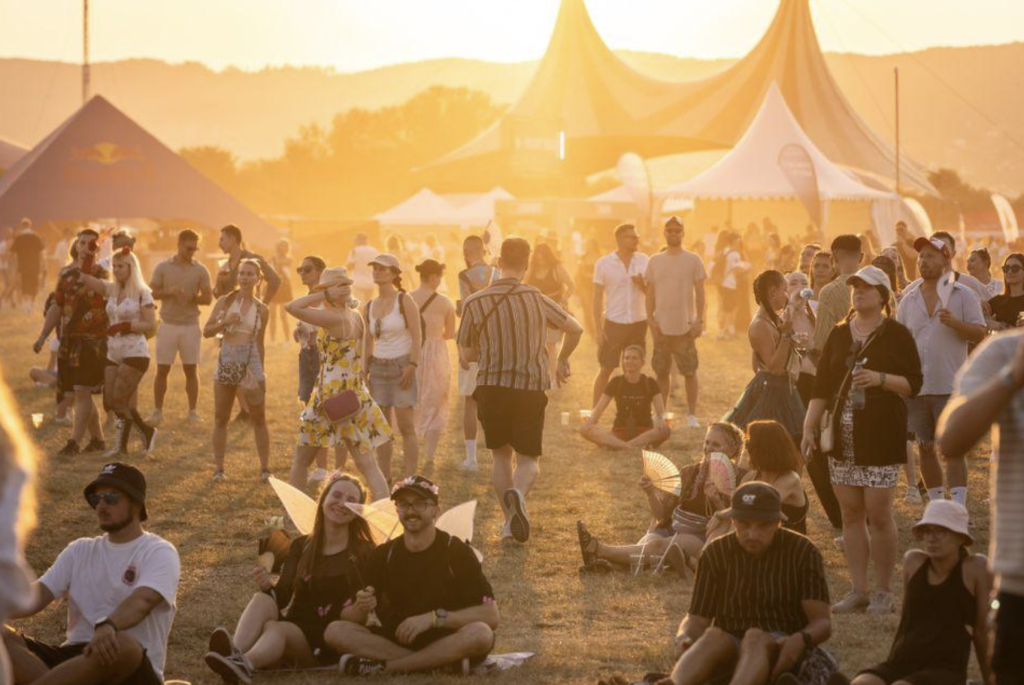
A team at Yale decided to find out by going where people actually use them. Led by first author Matthias Forstmann, a postdoctoral fellow, and senior author Molly Crockett, assistant professor of psychology, the researchers visited six multi-day arts and music festivals in the United States and the United Kingdom and surveyed more than 1,200 attendees.
One detail matters here. They only spoke to people who were not under the influence at the time. They asked about recent social experiences, mood, and which substances, if any, people had used. That let them study the afterglow rather than the trip itself.
The findings were published in January 2020 in the Proceedings of the National Academy of Sciences.
What the Yale team found
People who had recently taken psychedelics like LSD or psilocybin were more likely to report what the researchers called transformative experiences. These were experiences so profound that people felt they came out the other side changed, in some cases including shifts in their moral values.
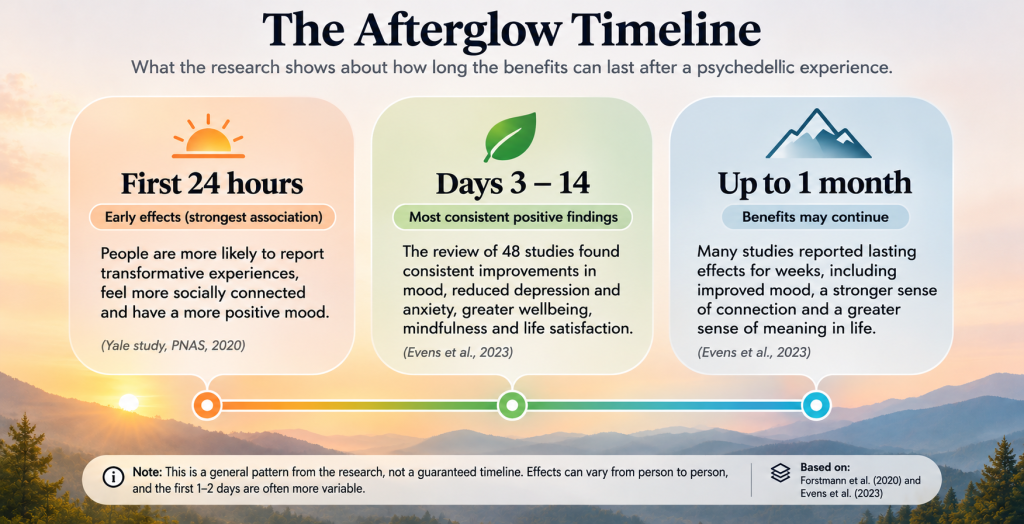
Those transformative experiences were in turn linked to two things: feeling more socially connected and a more positive mood. The effects were strongest in people who had taken psychedelics within the previous 24 hours.
The comparison groups are what make it interesting. People who hadn’t used anything, people who’d been drinking, and people who’d taken other drugs such as cocaine or opioids didn’t report transformative experiences, connectedness or positive mood to anything like the same degree.
Forstmann put it simply: people who take psychedelics “in the wild” report positive experiences very similar to those seen in controlled lab studies.
That’s a big deal. It suggests the afterglow isn’t just a product of a clinical room with a therapist sitting beside you. It shows up in a muddy field at a festival too.
What the study couldn’t tell us
Crockett was upfront about the limits. The study wasn’t designed to measure negative reactions, and those do happen with recreational use. Anyone who’s spent time around psychedelics has seen a hard night, or been through one.
A festival survey is also a snapshot. It can show that psychedelic use and better mood tend to go together, but it can’t prove that one caused the other. People who choose to take psilocybin at a festival may differ from those who don’t in all sorts of ways.
Crockett said more work is needed to understand which environmental factors push an experience toward the positive or the negative. Still, the team was encouraged that their results lined up with earlier lab research showing mood benefits in healthy volunteers and in patients living with anxiety and depression.
Zooming out: 48 studies on the afterglow
Since that Yale paper, the evidence has grown. In 2023, a group of German researchers (Ricarda Evens, Marianna Elisa Schmidt, Tomislav Majić and Timo Torsten Schmidt) published a systematic review in Therapeutic Advances in Psychopharmacology called The psychedelic afterglow phenomenon.
Rather than running a new experiment, they went through studies published between 1950 and 2021 and asked one question: what changes between one day and one month after taking a classic psychedelic? They looked at psilocybin, LSD, ayahuasca, DMT, 5-MeO-DMT and mescaline. Microdosing studies were left out, so this is about full experiences.
After screening nearly 4,000 records, they ended up with 48 studies covering 1,774 participants.
What changed
The researchers sorted the findings into 19 areas, and the overall direction was positive:
Fewer symptoms: reductions in depression, anxiety and other forms of distress across many studies
More wellbeing: better mood, life satisfaction, mindfulness and emotional regulation
Social effects: improved relationships and a stronger sense of connection, reported in nine studies
Shifts in outlook: more openness, optimism and sense of meaning in life
The most consistent results were for depression and stress, mindfulness, wellbeing and social effects, where 70 to 90 percent of the studies in each area pointed the same way. Psilocybin was one of the two most studied substances, alongside ayahuasca, with studies showing positive changes in mood, social connection and spirituality.
The review found no group-level worsening of symptoms, and no changes in mania, psychosis or cognitive performance.
When the afterglow shows up
This is the part I found most useful. The Yale study saw the strongest effects within 24 hours. The review, though, found that the first one to two days were the most variable, and the most consistent benefits appeared three to fourteen days after the experience. Some effects lasted longer, but the timing differed a lot from study to study.
In plain terms: the day after can be a mixed bag. Some people wake up glowing, others feel tired or a bit raw. The steadier benefits tend to settle in over the following week or two.
What about the downsides?
Only about half the studies said whether they even checked for side effects, which the authors flag as a real gap. Among those that did, the most common after-effect was headache, usually lasting a day or two, followed by trouble sleeping and feeling tense. One study recorded a severe flare-up of anxiety and a relapse into methamphetamine use. No serious adverse events were reported.
The authors were careful to point out that these results reflect what happens under favourable conditions, not what the average person should expect. Most of the studies took place in labs or ceremonial settings with support and aftercare built in. And 72 percent of them lacked a control group, blinding or a standardised protocol, so the evidence isn’t as solid as the headline numbers might make it sound.

What this means for our community
Put the two papers side by side and you get a fairly consistent picture. For many people, the effects of a psychedelic experience don’t stop when the trip wears off. Mood, connection and outlook can stay lifted for days or even weeks.
But neither paper says psychedelics are a guaranteed good time, or a replacement for professional care. Both point to the same lesson: context matters. Your mindset, your setting and what you do afterwards all shape how an experience lands.
A few things worth taking away:
Give the afterglow some room. If the steadiest benefits show up over the following week or two, that window is worth protecting. Try not to schedule your most stressful week straight after a journey.
Lean into connection. Both studies highlight social connectedness as a core part of the afterglow. Call someone. Have the conversation you’ve been putting off. Share what came up with a person you trust.
Treat integration as part of the experience. The review’s authors suggest future research should look at whether integration sessions help turn short-term shifts into lasting change. You don’t need to wait for the results. Journaling, long walks, talking it through or working with an integration coach are all ways to hold on to what you learned.
Respect the hard side. The Yale study didn’t measure difficult experiences, and the review probably undercounts them. Tough trips happen. Start low, know where your products come from, don’t mix with alcohol or other substances, and if you take any medication (especially antidepressants), speak to your doctor first.
Know your own history. If you or a close family member has a history of psychosis or bipolar disorder, psychedelics carry real risks. Most of the research here involved screened, healthy volunteers or carefully selected patients.
The bottom line
The afterglow is something people in our world have talked about for decades. It’s good to see science starting to catch up, both in controlled settings and out in the real world where most of us actually have these experiences.
The research is still young. Many studies are small, and the strongest evidence comes from supported settings. But the direction is encouraging, and it’s a good reason to take the days after a journey as seriously as the journey itself.
Have you noticed your own afterglow? I’d genuinely love to hear about it. Hit reply, or connect with me on LinkedIn.
Stay curious, stay safe.
Joseph Santiago Founder, Microdose Bros
Sources
- Forstmann, M., Yudkin, D. A., Prosser, A. M. B., Heller, S. M., & Crockett, M. J. (2020). Transformative experience and social connectedness mediate the mood-enhancing effects of psychedelic use in naturalistic settings. Proceedings of the National Academy of Sciences. Read the study
- Evens, R., Schmidt, M. E., Majić, T., & Schmidt, T. T. (2023). The psychedelic afterglow phenomenon: a systematic review of subacute effects of classic serotonergic psychedelics. Therapeutic Advances in Psychopharmacology, 13. Read the review
This article is for educational purposes only and isn’t medical advice. Microdose Bros does not make health claims about any product.


