


Free guide · Updated November 2026
Microdosing Magic Truffles: The Ultimate Guide
What microdosing is, how people do it, what the research actually shows and where the risks are. Clear, honest and written by people who work with truffles every day.
- How to measure a microdose properly
- The Fadiman Protocol and the Stamets Stack, explained
- The risks and medication interactions worth knowing
Join the Microdose Bros community
Weekly articles on microdosing, new research and psychedelics, straight to your inbox. Save 5% on your first order.
One email a week. No spam. Unsubscribe anytime. 18+ only.
In this guide
Truffles, mushrooms and psilocybin
Microdosing gets talked about far more than it gets explained. This guide covers what it is, how people do it, what the research actually shows, and where the risks are.
First, a quick clarification. Magic truffles and magic mushrooms come from the same kind of fungus. They’re just different parts of it. The mushroom is the fruiting body that grows above ground. The truffle is the sclerotium: a dense, hardened lump of mycelium that grows underground and stores the food reserves the fungus needs to survive harsh conditions, sometimes for years.
Both contain psilocybin, the same active compound. If you already know mushrooms, you’re not starting from scratch. The main practical differences are the form, the potency (which varies by species and strain) and the law. In the Netherlands, truffles are what smartshops can legally sell.
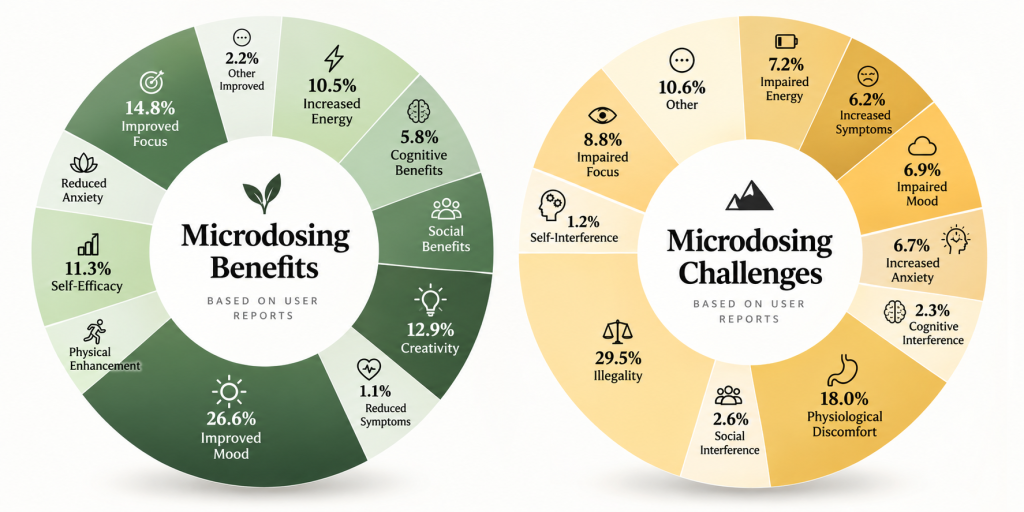 Self-reported benefits and challenges of microdosing. These reflect people’s experiences, not clinically proven effects.
What is microdosing?
Microdosing means taking a small fraction of a full dose, low enough that you shouldn’t notice a clear trip. Researchers call this sub-perceptual. A common rule of thumb is roughly one-tenth to one-twentieth of a full dose.
People usually try it hoping for a little more focus, creativity or emotional balance.
For fresh magic truffles, the range people usually cite is about 0.5 to 2 grams. Potency varies a lot between strains and batches, so treat that as a ballpark. Start at the low end, or below it if you’re new.
Want to skip the weighing? Our McMicrodose Starter Kit comes with six individually packed 1 gram portions of fresh truffles, so every dose starts from the same weight.
What does science say about microdosing?
Microdosing has attracted growing interest from researchers and from people curious about its effects on mood, creativity, focus and everyday well-being. Many people who microdose describe positive experiences, such as feeling more present, seeing daily challenges from a different angle, or becoming more aware of their thoughts and habits.
So what does the research actually tell us?
What researchers have found so far
Research into psilocybin microdosing is still young, and the findings are mixed.
Observational studies have reported encouraging patterns. One large study of more than 8,500 people found that those who microdosed reported lower levels of anxiety and depression than those who didn’t.1 But studies like this can’t show whether psilocybin caused the difference.
Placebo-controlled studies have been less convincing. In a large “self-blinding” study, participants prepared their own capsules so they didn’t know whether each one held a microdose or a placebo. Well-being improved in both groups, and the gap between them was small.2 A double-blind lab study of psilocybin mushroom microdosing likewise found no significant differences from placebo on most measures of mood and thinking.3
What people experience and what science can currently confirm are not always the same thing. Expectations play a real role, and researchers are still working out how low doses affect the brain and why some people seem to respond more than others.
A mindful approach to microdosing
Rather than expecting a particular outcome, we encourage curiosity, patience and self-awareness.
If you choose to explore microdosing, keep a simple journal of your mood, energy, sleep and overall well-being. It helps you notice patterns, while remembering that everyday changes can have many causes.
Microdosing isn’t a guaranteed shortcut to creativity, happiness or personal growth. Its benefits remain scientifically unproven, and it can involve risks or unwanted effects.
At Microdose Bros, we believe the best experiences begin with education, realistic expectations and informed choices.
Why spacing matters: tolerance
Tolerance to psilocybin builds quickly. If you dose two days in a row, the second dose usually does less than the first. That’s why every well-known protocol builds in rest days.
More frequent dosing doesn’t give you more. It gives you more tolerance and more total exposure. Every protocol in this guide leaves at least one full day between doses, and most leave two or more.
How to measure your microdose
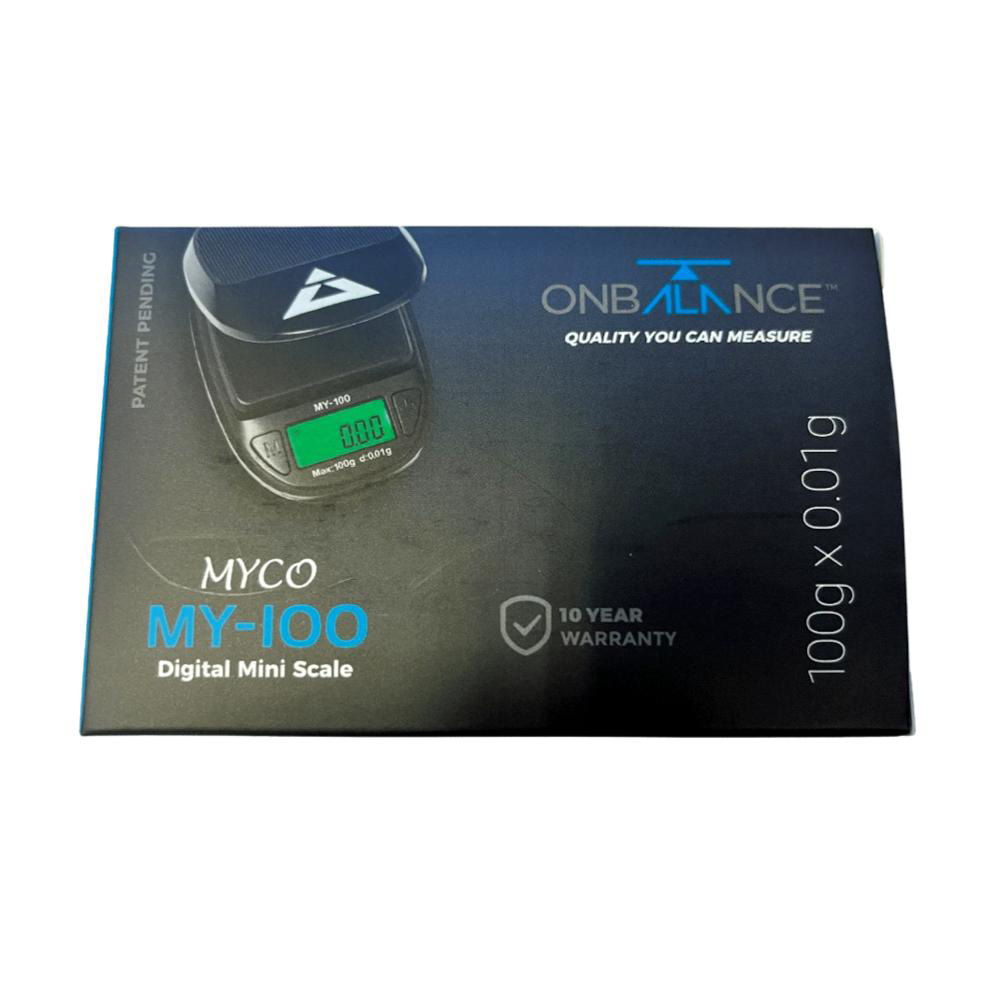
Unless your truffles come pre-portioned, you’ll need to divide them yourself. Don’t eyeball it. Use a scale that reads to 0.01 grams, and weigh every time.
Recommended
Microdosing Mini Scale: 100 g x 0.01 g
Reads to 0.01 grams, the precision a microdose needs. It’s small enough to fit in a drawer or a bag.
Fresh and dried truffles weigh very differently. Fresh truffles are mostly water, so a dried dose is only a fraction of the fresh weight. Never apply a fresh-truffle dose to dried truffles. Everything we sell is fresh, and the weights in this guide are for fresh truffles.
Ways to take a microdose
Most people take microdoses raw. The effects usually begin within 30 to 60 minutes, and slightly sooner when taken in liquid.
Raw
Chew thoroughly and swallow. The taste is earthy and a bit bitter, but it’s quick and simple.
Tea
Steep your dose in warm water, not boiling, because heat can break down psilocybin. Keep the steep short.
In food
Mix a measured dose into cold food like honey, pesto or chocolate spread. Skip the cooking. Food can also help if truffles make you queasy.
Paste
Blend the dose into a paste if you want to swallow it with as little taste as possible.
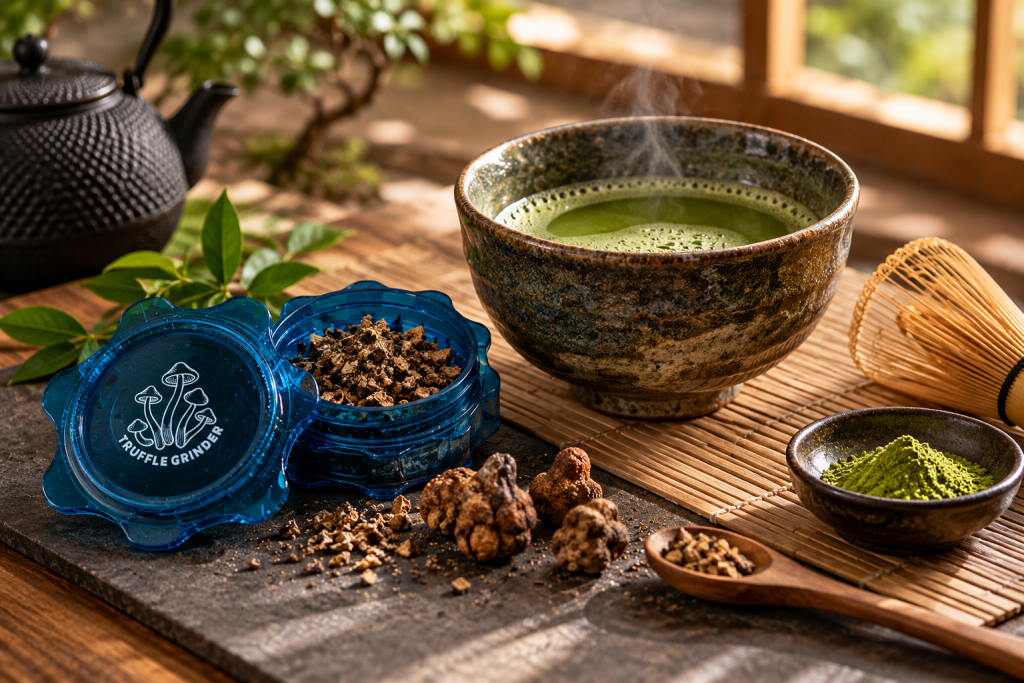 For tea or paste, a truffle grinder makes preparation easier.
What about Lemon Tek? Soaking truffles in citrus juice makes the effects arrive faster and feel stronger. That’s the opposite of what most microdosers want, so we don’t recommend it for microdosing.
Microdosing essentials
Everything you need to start
Fresh truffles, pre-portioned kits and the tools to measure properly. Shipped discreetly across Europe.


McMicrodose Premium 2 x 5g
Two sealed 5 g packs, so the second stays fresh while you use the first.Shop now →

McMicrodose Premium 2 x 10g
A larger supply in two sealed packs, for a full protocol cycle.Shop now →

Premium Microdosing Pack 2 x 10g
Our premium microdosing truffles in two sealed 10 g packs.Shop now →

Stamets Stack Formula
Lion’s mane and niacin together, for people following the Stamets Stack.Shop now →

The risks worth knowing about
A microdose is gentler than a full dose, but it isn’t risk-free.
Difficult moments
Psilocybin can bring up unwelcome thoughts or anxiety, even at low doses. If you’re already struggling, microdosing is not a substitute for professional support, so talk to your doctor first.
Medication and health
Antidepressants can change the effect, and lithium combined with psilocybin has been linked to serious reactions. Avoid psilocybin entirely if you or your close family have a history of psychosis or bipolar disorder. If you take any prescription medication, check with a doctor or pharmacist first.
Heart health
Psilocybin acts on serotonin 2B receptors. Other drugs that act on the same receptors, like the diet drug fen-phen, have damaged heart valves with long-term heavy use. This is a theoretical concern for microdosing, not a proven one. Long-term data doesn’t exist yet, though, so anyone with heart valve problems should avoid microdosing, and anyone planning to microdose for years should take this seriously.
Dependence
Psilocybin isn’t considered physically addictive, and it doesn’t act on the brain’s reward system the way many substances do. People can still use it in ways that don’t serve them, so keep your use deliberate.
Higher doses
Judgement drops quickly as doses rise, and there are reports of accidents at full doses. That’s one more reason to measure precisely and not redose.
Ground rules
- Measure every time. Never guess.
- Start low, go slow. Begin at the bottom of the range and give it time. Effects can take up to an hour, so don’t redose because you “feel nothing yet”.
- Choose a calm setting. Until you know how you react, microdose somewhere safe and quiet, with nothing demanding the next few hours.
- Take it on a light stomach. Wait around two hours after a meal for the cleanest onset.
- Check in with yourself. Skip it if you’re feeling low, anxious or overwhelmed. That’s when it’s most likely to backfire.
- Don’t mix. No alcohol or other drugs, and don’t drive until you know how you respond.
- Do it for you. Nobody should pressure you into it.
- Keep notes. Jot down mood, focus and sleep. After a cycle, you’ll know whether it’s actually doing anything.
If it’s more than you wanted: sit down, breathe slowly, drink some water and remind yourself it’s temporary. Having someone you trust nearby helps. It passes.
Weekly, free
Keep learning with the community
Every week we publish an educational article on microdosing, new psilocybin research and practical harm reduction.
Get the weekly article
No spam. Unsubscribe anytime. 18+ only.
Microdosing protocols
These schedules are community conventions, not clinically tested programmes. They all share one idea: spaced doses with rest days.
| Protocol | Schedule | Cycle |
|---|---|---|
| Fadiman | 1 day on, 2 days off | 4–8 weeks, then 2–4 weeks off |
| Stamets Stack | 4 days on, 3 days off | Up to 4 weeks, then at least 2 weeks off |
| Intuitive | By feel, at least 2 days apart | After learning your response |
The Fadiman Protocol
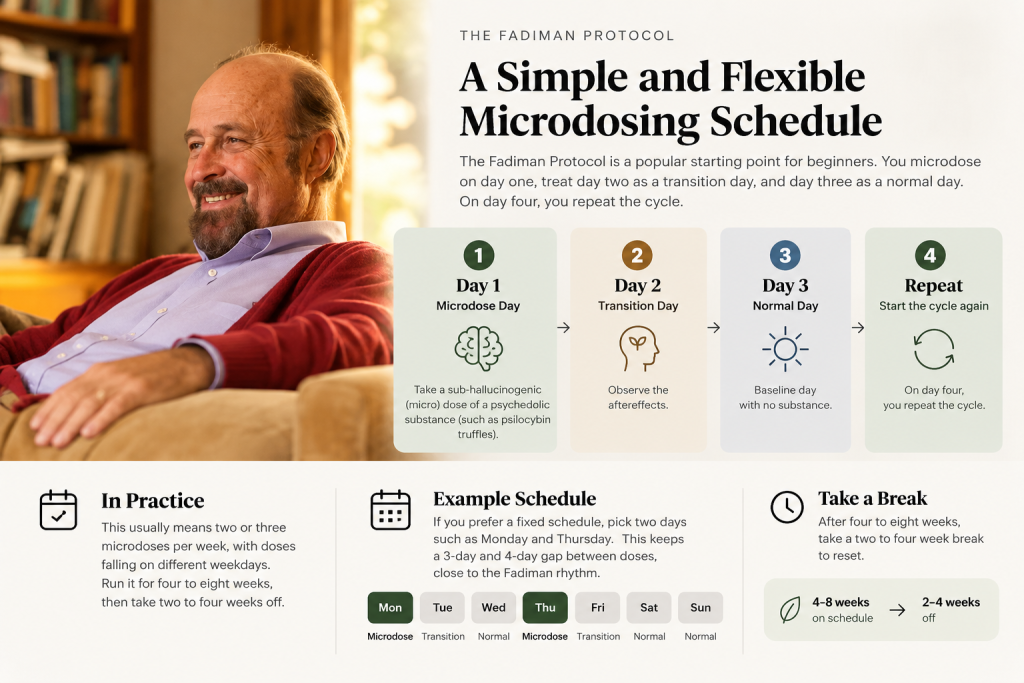
Developed by researcher James Fadiman, this is the usual starting point for beginners. You microdose on day one, treat day two as a transition day and day three as a normal day. On day four, you start the cycle again.
That works out at two or three doses a week, falling on different weekdays. Run it for four to eight weeks, then take two to four weeks off.
If you prefer a fixed schedule, pick two days, such as Monday and Thursday. That keeps a three- and four-day gap between doses, close to the Fadiman rhythm.
The Stamets Stack
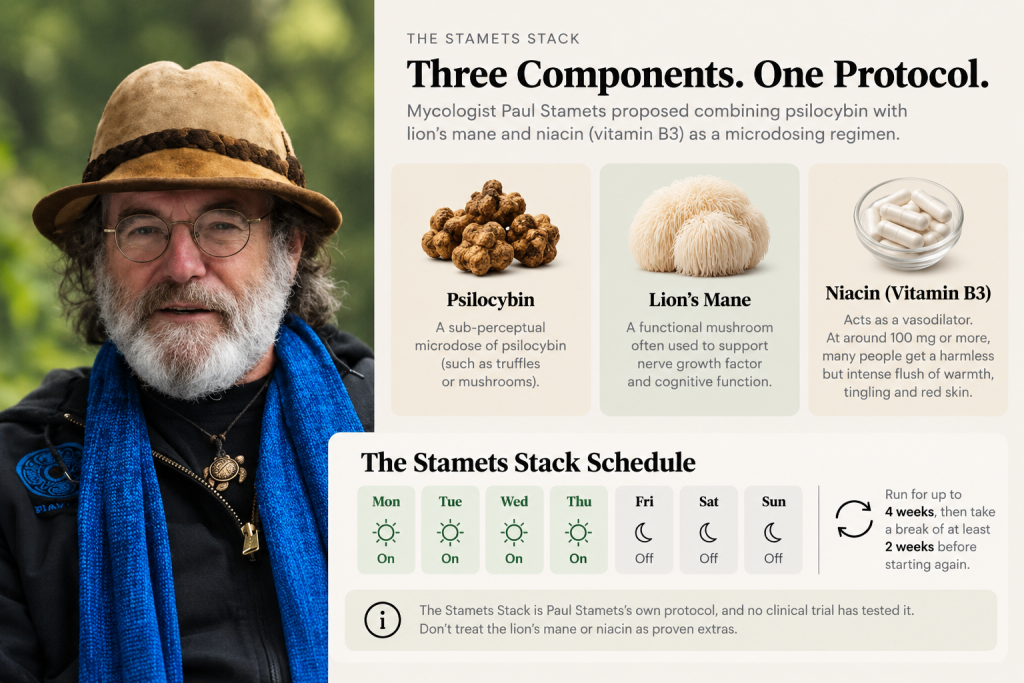
Mycologist Paul Stamets proposed combining psilocybin with lion’s mane and niacin (vitamin B3). The schedule is four consecutive days on, then three days off. Run it for up to four weeks, then rest for at least two weeks before starting again.
Niacin is the sticking point for some people. At around 100 mg or more, many people get a harmless but intense flush of warmth, tingling and red skin. If that bothers you, halve the niacin. The flush usually eases as your body adjusts.
The stack is Stamets’s own proposal, and no clinical trial has tested it, so don’t treat the lion’s mane or niacin as proven extras. If you want to follow it, the Stamets Stack Formula puts both together.
The intuitive approach
Some people follow Fadiman for a month, learn how they respond, and then dose by feel. Keep the same spacing: at least two days between doses, so tolerance doesn’t build up.
The nightcap method
A few people take a microdose in the evening, about an hour before bed. Reports of vivid dreams and good sleep are anecdotal, and for some people psilocybin makes sleep lighter, not deeper. If you want to try it, pick a night when you don’t need to be sharp the next morning.
Every other day?
Some people dose every other day when the standard protocols don’t seem to work. Because of tolerance, that mostly means more exposure for little extra effect, so we’d try a different approach first.
Frequently asked questions
Will I trip on a microdose?
You shouldn’t. A microdose is meant to be sub-perceptual. If you notice clear visual or mental changes, the dose was higher than a microdose, so take less next time.
How long before I notice anything?
Many people don’t notice a single dose at all. That’s normal. Judge it over a full cycle, using your journal, rather than day by day.
Can I microdose if I take antidepressants?
Talk to your doctor or pharmacist first. Antidepressants can change how psilocybin works, and lithium combined with psilocybin has been linked to serious reactions.
Are microdosing truffles fresh or dried?
All our truffles are fresh. Dried truffles weigh far less than fresh ones, so never apply a fresh-weight dose to dried truffles.
How should I store my truffles?
Keep them sealed in the fridge. They typically stay fresh for two to three months. The date on the bag is the last day we can sell them, and refrigerated truffles often stay good beyond it. Read our full guide on how to store magic truffles.
Do I need a scale if I buy a starter kit?
The McMicrodose Starter Kit is pre-portioned into 1 gram packs, so you can start without one. If you want to take less than a full portion, a 0.01 g scale lets you split it accurately.
Is microdosing magic truffles legal?
In the Netherlands, magic truffles are legal to buy and sell. Laws differ from country to country, so check the rules where you live.
Final thoughts
Microdosing depends heavily on quality. Old stock or a very mild strain will give you inconsistent results, so start with fresh, reliable truffles.
After your first cycle, or any time something doesn’t feel right, change the protocol or the method, or stop altogether. Stopping is always a valid choice.
If you’re curious, go in with open eyes. The science doesn’t promise an effect, so stay careful, keep your doses measured and judge your own results honestly.
Don’t miss the next article
Research summaries, practical guides and honest answers about microdosing and psychedelics, once a week.
Join the community
No spam. Unsubscribe anytime. 18+ only.
Sources
- Rootman, J. M. et al. (2021). Adults who microdose psychedelics report health related motivations and lower levels of anxiety and depression compared to non-microdosers. Scientific Reports, 11, 22479. doi.org/10.1038/s41598-021-01811-4
- Szigeti, B. et al. (2021). Self-blinding citizen science to explore psychedelic microdosing. eLife, 10, e62878. doi.org/10.7554/eLife.62878
- Cavanna, F. et al. (2022). Microdosing with psilocybin mushrooms: a double-blind placebo-controlled study. Translational Psychiatry, 12, 307. doi.org/10.1038/s41398-022-02039-0
This guide is for educational purposes only and is not medical advice. For adults 18+ only. Microdose Bros does not ship to the USA. Laws on psilocybin truffles vary by country, so check your local regulations.


Zita DiMeo
Do ground up dehydrated mushrooms put into a capsule have a shelf life? That is, after dehydrating, grinding up and encapsulating, do I need to worry about spoilage? Thanks!
Joseph Santiago
Yes, ground up dehydrated mushrooms placed into capsules do have a shelf life. Properly dehydrated, ground, and encapsulated mushrooms, when stored in a cool, dark, and dry place, can maintain their quality for several months to a year or even longer.
Joseph Santiago
Hi Zita Yes, ground-up dehydrated mushrooms in capsules do have a shelf life. While properly dehydrated and stored mushrooms are quite stable, they will gradually lose potency over time. For best results, store the capsules in an airtight container in a cool, dark, and dry place. Exposure to light, heat, and moisture can accelerate degradation.
Typically, potency starts to decline after about 6 to 12 months, though they can still be effective beyond that if stored correctly. Adding a food-safe desiccant packet to your storage container can further extend freshness by controlling moisture. Always check for signs of spoilage like unusual odors or discoloration before consuming.