


Many people assume that psilocybin — the active compound in magic truffles and magic mushrooms — works primarily by increasing dopamine in the brain.
After all, users often report feelings of euphoria, enhanced motivation, a deeper appreciation for life, and a renewed sense of purpose. These are experiences we commonly associate with dopamine — the so-called “reward chemical.”
But the science tells a more interesting story.
While psilocybin can indirectly influence dopamine activity, its primary mechanism operates through an entirely different system. To understand why magic truffles feel so profoundly different from conventional stimulants, you first need to understand the difference between these two neurotransmitter systems — and exactly where psilocybin fits in.

What Is Dopamine?
Dopamine is a neurotransmitter that plays a central role in:
- Motivation and drive
- Reward and reinforcement
- Learning and memory
- Goal-directed behaviour
- Habit formation
Despite being routinely described as the “happiness chemical,” modern neuroscience has refined this view considerably. Dopamine is now understood as a chemical of pursuit — it drives us to seek rewards, repeat beneficial behaviours, and learn from our experiences.
Eating great food, hitting a personal best at the gym, falling in love, receiving a social media notification — all of these can trigger dopamine release to varying degrees.
Addictive substances like cocaine and methamphetamine work precisely because they produce massive, artificial dopamine surges that powerfully reinforce repeated use.
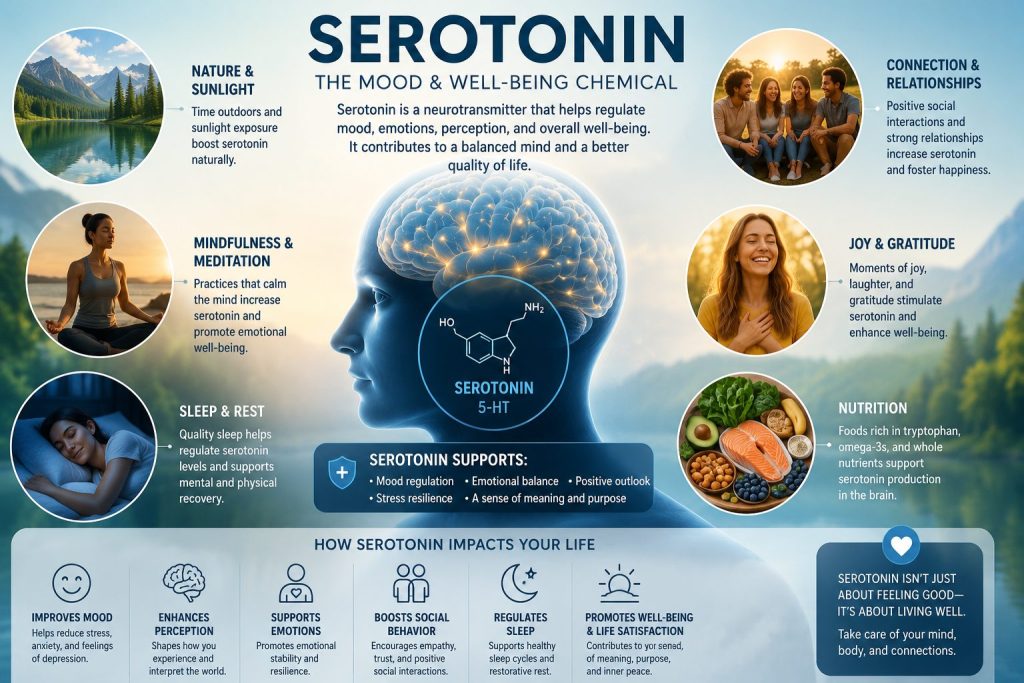
What Is Serotonin?
Serotonin is a separate neurotransmitter involved in:
- Mood regulation
- Emotional processing
- Perception and sensory experience
- Social behaviour
- Sleep
- Sense of meaning and well-being
Where dopamine is about wanting and seeking, serotonin is more concerned with how we experience and interpret the world. It shapes the quality of our inner life, our emotional tone, and our sense of connection to the present moment.
Psilocybin operates primarily within the serotonin system.

How Psilocybin Works in the Brain
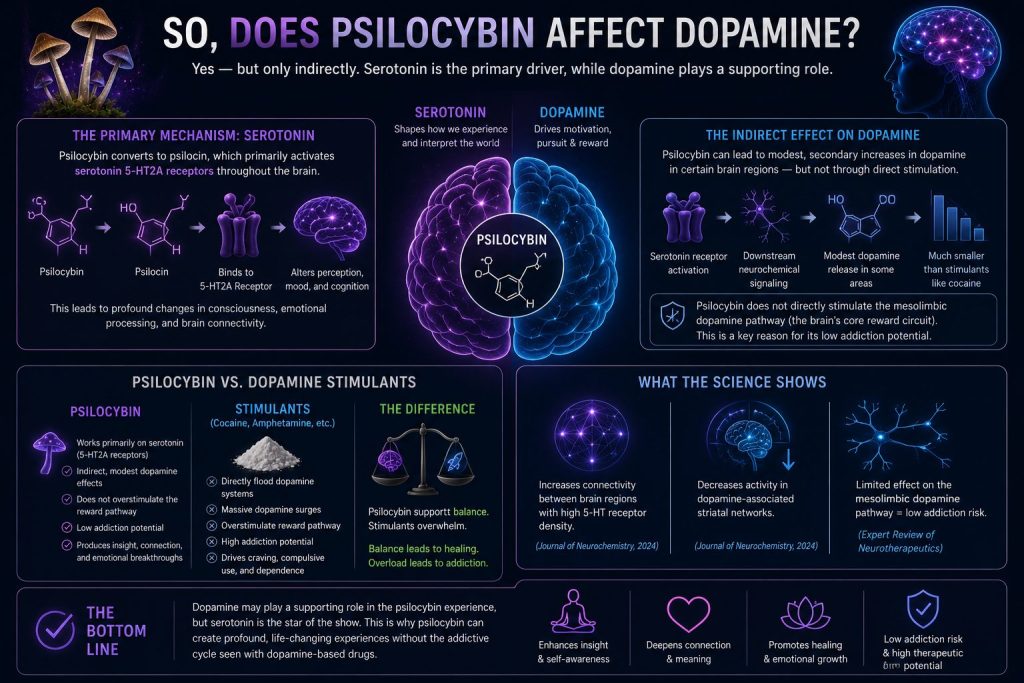
When you consume magic truffles, your body rapidly converts psilocybin into its active form: psilocin.
Psilocin closely resembles serotonin in its molecular structure and binds to multiple serotonin receptors throughout the brain. The most critical of these is the 5-HT2A receptor.
Research published in Frontiers in Systems Neuroscience (2025) confirms that activation of the 5-HT2A receptor is the primary driver behind psilocybin’s effects — including altered perception, increased introspection, emotional breakthroughs, and enhanced feelings of connection.
A 2024 review in the Journal of Neurochemistry found that psilocybin significantly increases functional connectivity between brain regions with high 5-HT receptor density, while decreasing activity in dopamine-associated striatal networks. This supports the idea that serotonin — not dopamine — is the dominant driver of the psychedelic experience.
Beyond its effects on receptors, psilocybin also appears to stimulate neuroplasticity — the brain’s ability to form new connections. According to a review by the OPEN Foundation (2025), psilocybin activates BDNF (brain-derived neurotrophic factor) and mTOR pathways through the 5-HT2A receptor, promoting the growth of new dendritic spines and synaptic connections — particularly in the prefrontal cortex and hippocampus.
So, Does Psilocybin Affect Dopamine?
Yes — but only indirectly.
The brain’s neurotransmitter systems don’t operate in isolation. Serotonin and dopamine are in constant dialogue with one another.
When psilocybin activates serotonin receptors, this can trigger downstream changes in dopamine activity in certain brain regions. Some studies suggest there are modest increases in dopamine release following psilocybin. However, these changes are significantly smaller than those produced by stimulants like cocaine or amphetamine.
Importantly, psilocybin does not directly stimulate the mesolimbic dopamine pathway — the brain’s core reward circuit. A peer-reviewed study in Expert Review of Neurotherapeutics notes that psilocybin’s limited effect on this pathway is a key reason why it carries such a low addiction potential compared to other recreational substances.
In short: dopamine may play a supporting role, but serotonin is the star of the show.

Why Does Psilocybin Feel So Good Without a Dopamine Surge?
This is where many people get confused.
If psilocybin doesn’t flood the brain with dopamine, why do so many users describe the experience as profound, euphoric, or even life-changing?
The answer lies in how the serotonin system shapes emotional experience. Psilocybin appears to temporarily reorganise the way brain networks communicate with one another — particularly by reducing activity in the Default Mode Network (DMN), the brain region associated with the ego, rumination, and rigid self-referential thinking.
When this activity decreases, users often report:
- Greater appreciation for life
- Increased emotional openness and vulnerability
- A sense of connection to others or to nature
- Reduced mental chatter and anxious thought patterns
- Moments of genuine awe, wonder, and meaning
- A renewed sense of purpose
This experience is deeply different from the sharp, pursuit-driven rush associated with dopamine stimulant drugs. Many people describe it not as a “high” but as a reconnection — to themselves, to other people, and to the present moment.
Psilocybin vs. Dopamine-Based Substances
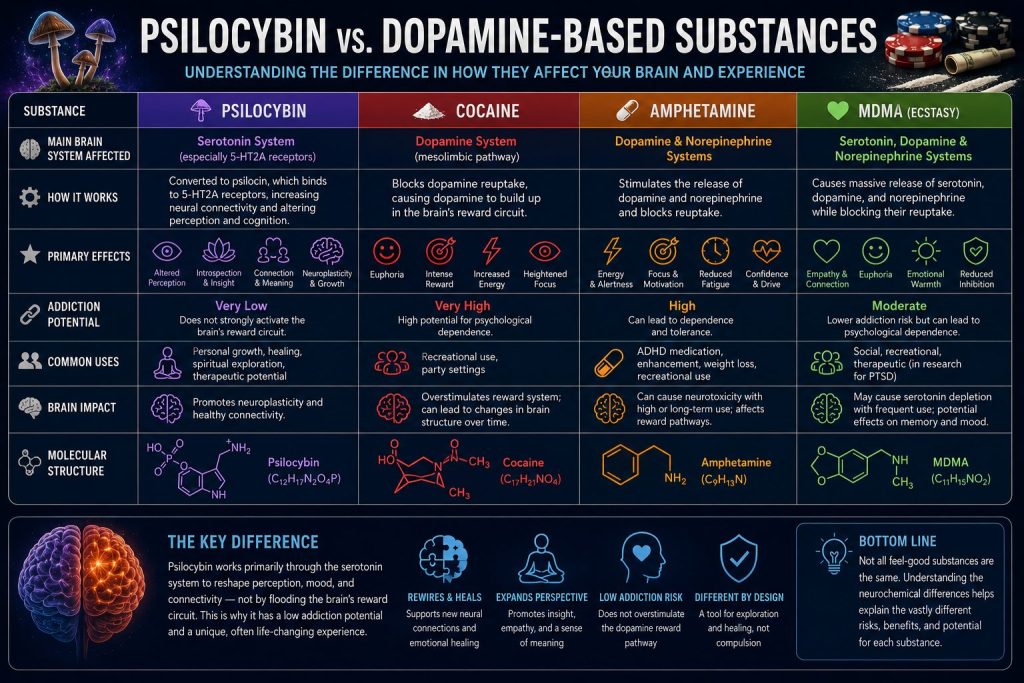
Understanding the neurochemical differences helps explain why magic truffles feel so distinct from most recreational drugs.
Cocaine blocks dopamine reuptake, causing levels to spike dramatically and powerfully reinforcing repeated use.
Amphetamine and Adderall stimulate the release of dopamine and norepinephrine, producing energy, focus, and drive.
MDMA triggers a large release of serotonin alongside increased dopamine and norepinephrine — producing empathy, emotional openness, and euphoria simultaneously.
Psilocybin primarily activates serotonin receptors. Any dopamine changes are modest and secondary. The subjective experience is driven more by changes in brain network connectivity than by reward pathway stimulation.

What Creates the Biggest Dopamine Spikes?
It’s worth noting that dopamine itself is entirely healthy. It underpins our motivation, creativity, and ability to pursue goals. The problems emerge when substances or behaviours generate unnaturally large or frequent dopamine spikes that lead to compulsive patterns.
Some of the most potent dopamine triggers include:
Social media — Platforms like Instagram, TikTok, and YouTube are engineered around variable reward schedules. Every like, notification, or new video produces a micro-dopamine hit that drives compulsive checking behaviour.
Gambling — Many addiction specialists consider gambling one of the most potent behavioural dopamine activators because uncertainty and anticipation are especially powerful triggers.
Ultra-processed food — Combinations of sugar, fat, and salt are specifically engineered to be hyperpalatable, activating reward circuits and contributing to cravings.
Pornography — Novel sexual content continually activates dopamine response through what researchers call the Coolidge Effect — the tendency for new stimuli to trigger continued interest and arousal.
Addictive drugs — Cocaine, methamphetamine, opioids, nicotine, and alcohol all directly stimulate reward pathways with varying degrees of intensity, and are associated with a higher risk of physical and psychological dependence.
Why Is Psilocybin Considered to Have Low Addiction Potential?
Researchers widely consider psilocybin one of the least addictive psychoactive substances studied. Several factors contribute to this:
- It doesn’t strongly activate the mesolimbic dopamine pathway. This is the circuit most directly involved in the development of physical addiction.
- It builds tolerance rapidly. Users who take psilocybin on consecutive days find that the effects diminish sharply, making compulsive use self-limiting.
- It doesn’t produce craving or withdrawal. Unlike alcohol, opioids, or stimulants, psilocybin is not associated with withdrawal symptoms when use is stopped.
- The experience itself often discourages immediate repetition. Many users feel the need to spend days, weeks, or even months integrating a profound psychedelic experience before considering another. This is behaviorally opposite to the compulsive re-dosing pattern seen with addictive substances.
According to a clinical protocol overview published on ClinicalTrials.gov, there is no documented case of someone developing an addiction to psilocybin or magic mushrooms.
Beyond that, emerging research suggests psilocybin may actually help treat addiction. A 2025 study in Frontiers in Systems Neuroscience highlights psilocybin’s potential to rewire maladaptive neural pathways associated with substance use disorders, while a preprint from 2025 (bioRxiv) found that psilocybin decreased reward-seeking behaviour through long-term changes in the prefrontal cortex.
Preliminary clinical trials have also shown encouraging results for psilocybin-assisted therapy in people struggling with alcohol and nicotine dependence.
What About Microdosing? Does That Affect Dopamine?
Microdosing — taking sub-perceptual doses of psilocybin that don’t produce a full psychedelic experience — has grown in popularity for its reported effects on mood, creativity, and focus.
Current research suggests that microdosing, like full-dose experiences, primarily works through the serotonin system rather than via significant dopamine increases.
While indirect changes in dopamine signalling may occur at some level, researchers believe the reported benefits of microdosing — including improved emotional flexibility, reduced anxiety, and increased cognitive openness — are more likely related to ongoing changes in serotonin receptor sensitivity and brain network communication.
That said, microdosing research is still in its early stages, and more controlled trials are needed to fully understand its mechanisms.
Curious about microdosing? Explore our Microdosing Starter Guide and browse our microdosing products.
The Bigger Picture: Psilocybin as a Neurological Reset
Rather than acting as a chemical shortcut to pleasure — flooding the brain with dopamine and hijacking reward circuits — psilocybin appears to work more like a neurological reset button.
It temporarily alters how the brain processes information, emotion, and self-perception through the serotonin system. This may help dissolve rigid thought patterns, open the door to new perspectives, and allow people to re-engage with life in a more present, connected way.
This is likely why so many people describe psychedelic experiences not as getting “high,” but as gaining clarity, experiencing breakthroughs, or reconnecting with what matters most to them.
Final Thoughts
Does psilocybin affect dopamine? Yes — but only indirectly.
The psychedelic effects of psilocybin are primarily driven by serotonin system activation, particularly at the 5-HT2A receptor. While modest downstream changes in dopamine may occur in certain brain regions, these are secondary effects. The core of the experience — perceptual shifts, emotional release, neuroplasticity, and altered consciousness — is fundamentally serotonergic.
This explains why magic truffles feel so different from stimulants, social media, gambling, and other dopamine-heavy experiences. The power of psilocybin doesn’t come from creating a rush. It comes from temporarily changing how the brain interprets the world — and for many people, that change can be profound and lasting.
Explore More at Microdose Bros
Ready to learn more or start your own journey?
- 🍄 Shop Magic Truffles — browse our full range of magic truffles
- 🔬 Microdosing Guide — everything you need to know about getting started
- 📖 The Microdose Bros Blog — science, education, and personal growth
Follow Microdose Bros
Stay connected for the latest in psychedelic science, wellness, and community:
- 📸 Instagram: instagram.com/microdosingbros
- 🎵 TikTok: tiktok.com/@microdosingbros
- 💼 LinkedIn: linkedin.com/company/microdosingbros
- 👥 Facebook: facebook.com/microdosingbros
Disclaimer: This article is for educational and informational purposes only. Magic truffles and psilocybin-containing products are subject to different legal regulations depending on your country and region. Always check your local laws before purchasing or consuming any psychedelic product. Nothing in this article constitutes medical advice.


