


How an ancient sacred sacrament became one of the most talked-about substances in modern science, wellness, and technology
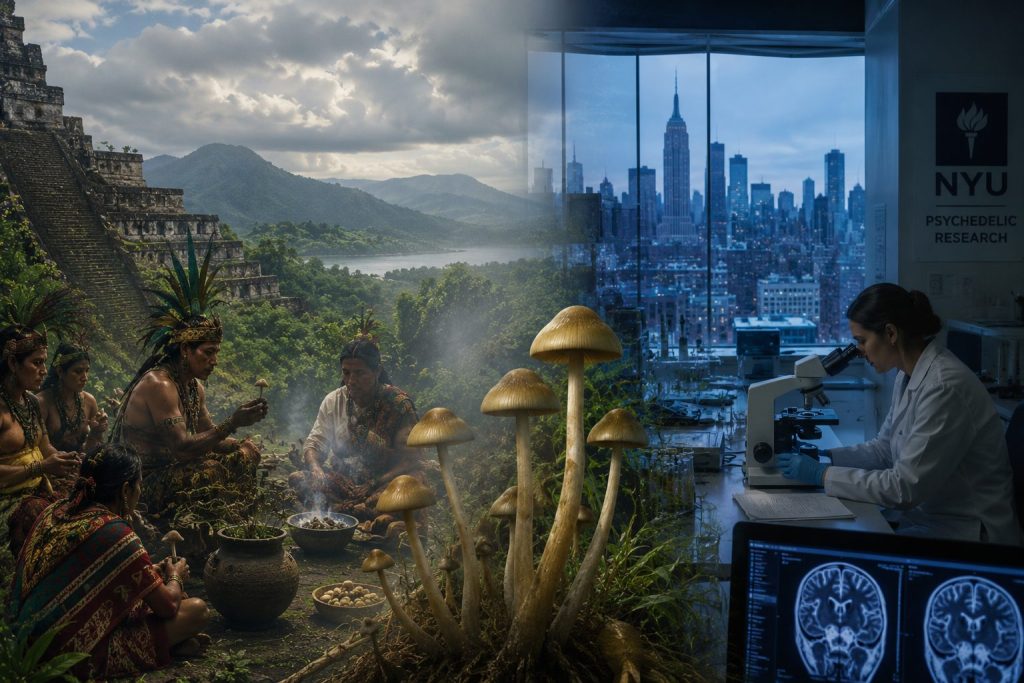
Thousands of years before Silicon Valley executives began discussing microdosing over coffee, before neuroscientists placed psilocybin users inside MRI machines, and long before the psychedelic renaissance captured headlines around the world, magic mushrooms were already considered sacred.
In the mountains and forests of Mesoamerica, indigenous peoples consumed certain species of psilocybin mushrooms during ceremonies designed to heal the sick, communicate with the divine, and gain insight into life’s deepest mysteries.
The Aztecs had a name for these mushrooms:
Teonanácatl.
Translated from Nahuatl, it means “flesh of the gods.”
Today, more than five centuries later, the same compound responsible for those ancient spiritual experiences, psilocybin, is being studied at institutions such as Johns Hopkins University, Imperial College London, and NYU.
The journey from Aztec temples to Silicon Valley is one of history’s most fascinating stories.
The sacred mushrooms of ancient Mexico
When many people think about magic mushrooms, they imagine the counterculture movement of the 1960s.
In reality, their history stretches back far beyond Woodstock.
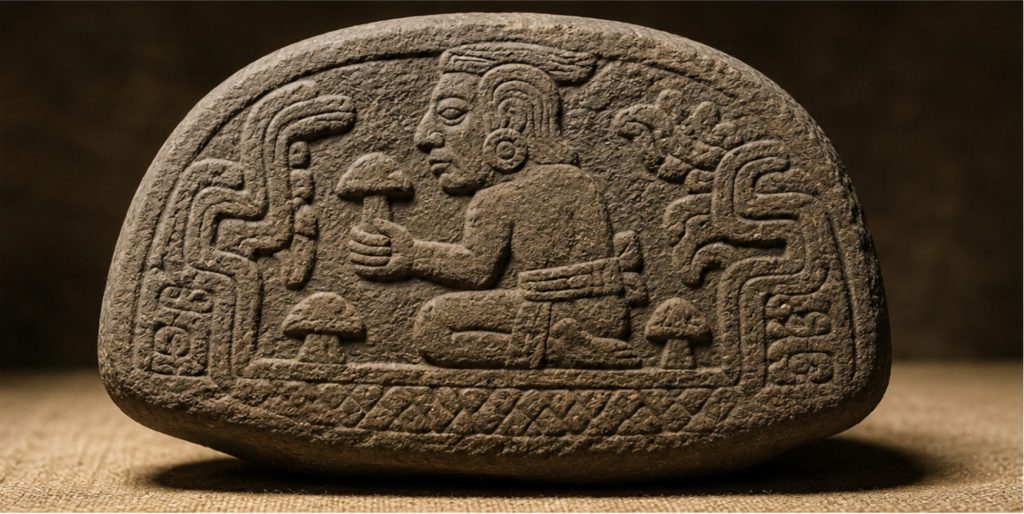
Archaeologists have discovered mushroom stones and ceremonial artifacts throughout Central America dating back more than 2,000 years. These artifacts suggest that psychoactive mushrooms played an important role in religious and spiritual life long before the arrival of Europeans.
Among the Aztecs, mushrooms were not viewed as recreational substances.
They were sacred tools.
Historical accounts describe ceremonial gatherings where mushrooms were consumed during important religious festivals, healing rituals, and divination ceremonies. Priests and spiritual leaders believed these experiences allowed communication with divine forces and provided insight into the nature of reality.
To the Aztecs, altered states of consciousness were not something to be feared.
They were something to be respected.
The experience was often treated with the same reverence that many cultures reserve for prayer, meditation, or pilgrimage.
When the Spanish arrived
Everything changed in the early 1500s.
After the Spanish conquest of Mexico, Catholic authorities viewed many indigenous ceremonies as threats to Christian doctrine.
Reports from missionaries described mushroom ceremonies with a mixture of fascination and alarm.
The sacred mushrooms that indigenous communities had used for generations became associated with pagan practices and were actively suppressed.
Many ceremonies were driven underground.
Yet despite centuries of persecution, the knowledge survived.
In remote regions of Oaxaca and other parts of Mexico, indigenous communities quietly preserved their traditions, passing them from one generation to the next.
Without those communities, the modern psychedelic renaissance might never have happened.
The woman who reintroduced magic mushrooms to the world
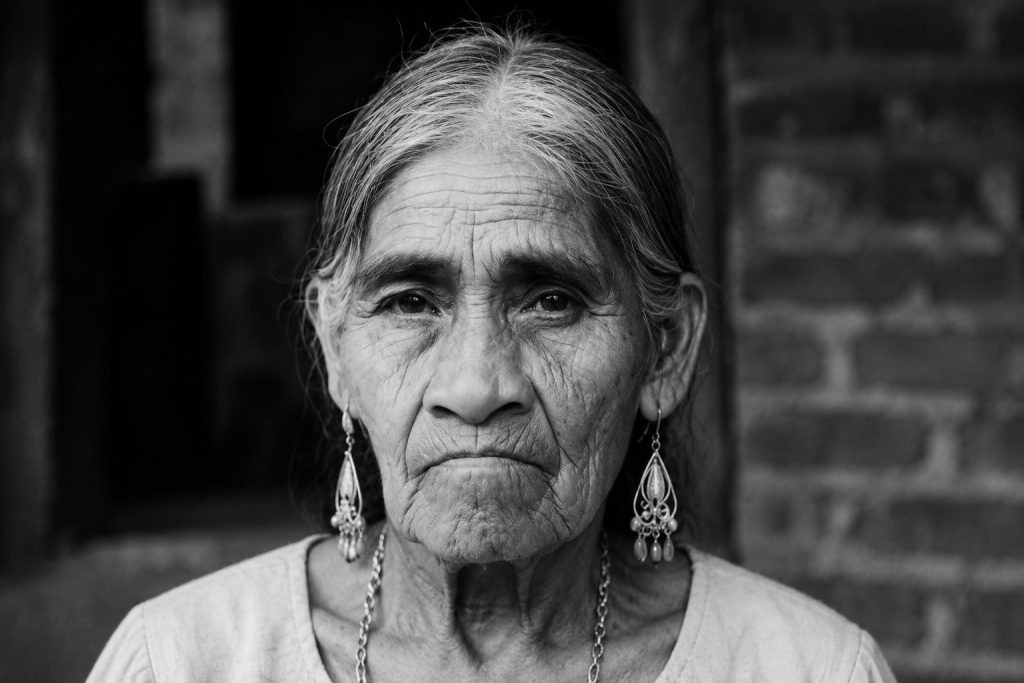
No individual played a larger role in modern mushroom history than María Sabina.
Born in 1894 in Oaxaca, Mexico, Sabina was a Mazatec healer known as a curandera. She conducted sacred ceremonies called veladas, using psilocybin mushrooms to help people seek healing, guidance, and spiritual understanding.
For decades, her work remained largely unknown outside her community.
That changed in 1955.
An American banker and amateur ethnomycologist named R. Gordon Wasson traveled to Oaxaca and participated in one of Sabina’s ceremonies.
His experience profoundly changed him.
In 1957, Wasson published an article in Life Magazine titled “Seeking the Magic Mushroom.”

A Magazine Cover That Changed The World
Long before podcasts, YouTube channels, or social media, magazines shaped public opinion. When Life Magazine published Gordon Wasson’s account of sacred mushroom ceremonies in 1957, millions of Americans encountered psilocybin mushrooms for the first time. It marked the moment an ancient indigenous tradition began its journey into modern science, psychology, and popular culture.
This small section beneath the image will increase engagement, improve readability on mobile, and help connect María Sabina’s story to the psychedelic revolution that followed.
Millions of Americans read it.
For many people, it was their first introduction to psilocybin mushrooms.
Almost overnight, Western interest in psychedelic mushrooms exploded.
What had once been hidden in remote mountain villages entered global consciousness.
The psychedelic revolution
The timing could not have been more significant.
The late 1950s and 1960s saw an explosion of interest in psychology, consciousness, and human potential.
Researchers at Harvard University, including Timothy Leary and Richard Alpert (later known as Ram Dass), began experimenting with psilocybin.
Artists, musicians, writers, and spiritual seekers followed.
Magic mushrooms became closely associated with the broader psychedelic movement.
For some, they represented freedom.
For others, they represented danger.
Governments around the world responded with increasing restrictions.
Research slowed dramatically.
For decades, much of the scientific exploration of psychedelics remained frozen.
But the story was far from over.
The modern psychedelic renaissance

Fast forward to today.
Psilocybin is once again attracting serious scientific attention.
Researchers at Johns Hopkins University have published studies investigating psilocybin’s potential role in treating depression, end-of-life anxiety, addiction, and other mental health challenges.
Scientists are exploring how psilocybin affects brain networks associated with self-reflection, emotional processing, and cognitive flexibility.
Brain imaging studies have revealed fascinating changes in communication patterns between different regions of the brain during psychedelic experiences.
While research continues and many questions remain unanswered, one thing is clear:
The scientific community is taking psilocybin seriously.
What was once dismissed as a fringe topic has become one of the most exciting areas of modern neuroscience.
From counterculture to Silicon Valley
Perhaps the most unexpected chapter in mushroom history is unfolding today.
In recent years, entrepreneurs, executives, athletes, artists, and creatives have shown growing interest in psychedelics.
Particularly notable is the rise of microdosing, the practice of consuming very small amounts of psilocybin without experiencing a full psychedelic journey.
Advocates claim microdosing may support creativity, focus, mood, and problem-solving, though scientific research remains ongoing.
This trend has become especially visible within technology and startup circles.
For many modern users, psilocybin is not simply about recreation.
It is about self-exploration, creativity, performance, and personal growth.
In some ways, the motivations echo those of ancient cultures.
The tools have remained the same.
The context has changed.
Magic mushrooms vs magic truffles: what’s the difference?

One of the most common questions among newcomers is the difference between magic mushrooms and magic truffles.
Both contain naturally occurring psilocybin.
Both can produce psychedelic effects.
However, they are different parts of the fungal organism.
Magic mushrooms are the fruiting bodies that grow above ground.
Magic truffles, also known as sclerotia, develop below ground as dense nutrient storage structures.
Many people assume mushrooms are automatically stronger than truffles.
In reality, potency depends on species, genetics, growing conditions, storage, and dosage.
Both can provide meaningful psychedelic experiences.
In the Netherlands, fresh magic truffles remain legal, making them one of the most accessible ways for adults to explore psilocybin responsibly.
Popular options include:
- Nirvana Magic Truffles
- Royal Dutch Magic Truffles
- High Hawaiians Magic Truffles
- Mexicana Del Sol Magic Truffles
For those interested in cultivation, popular mushroom grow kits include:
The Mazatapec strain is especially noteworthy because it traces its origins to the Mazatec region of Mexico, the same region associated with María Sabina and many traditional mushroom ceremonies.
What would the Aztecs think today?
It is impossible to know exactly what the Aztecs would think if they could see the modern psychedelic world.
They would likely be surprised to see scientists studying brain scans, entrepreneurs discussing microdosing, and governments debating medical legalization.
Yet they might also recognize something familiar.
Across thousands of years and vastly different cultures, human beings continue asking the same questions:
Who am I?
Why am I here?
How can I heal?
What lies beyond ordinary consciousness?
The tools may evolve.
The questions remain remarkably unchanged.
And that may be why the story of magic mushrooms continues to captivate generation after generation.
From ancient temples to modern laboratories, from sacred ceremonies to Silicon Valley boardrooms, the journey of psilocybin is ultimately a story about humanity’s endless search for meaning.
Continue The Journey
The story of magic mushrooms is still being written.
From the sacred ceremonies of the Aztecs and Mazatecs to modern scientific research and personal exploration, psilocybin continues to inspire curiosity about consciousness, creativity, healing, and the human experience.
Whether you’re a seasoned psychonaut, a curious newcomer, or simply fascinated by the history of these remarkable fungi, education remains one of the most valuable tools on the path. Understanding the traditions, science, risks, and responsibilities surrounding psychedelics can help create a safer and more meaningful relationship with them.
Follow Microdose Bros for educational content, cultivation tips, psychedelic history, research updates, and responsible guidance:
Instagram
https://www.instagram.com/microdosebros/
TikTok
https://www.tiktok.com/@microdosebros
YouTube
https://www.youtube.com/@microdosebros
Facebook
https://www.facebook.com/microdosebros
The journey that began thousands of years ago in the mountains of Mexico continues today through researchers, cultivators, explorers, and everyday people seeking a deeper understanding of themselves and the world around them.
Wherever your curiosity leads, approach with respect, preparation, and an open mind. The most meaningful psychedelic experiences are rarely about escaping reality. More often, they are about seeing it more clearly.


